If you publish or present research, you will eventually be targeted by two closely related scams: predatory journals and predatory conferences. They share the same business model and often the same operators, but they trap you in slightly different ways. Knowing how each works, and how they overlap, is the best protection for your money and your reputation.
What they have in common
Both predatory journals and predatory conferences exist to collect fees while providing little or none of the scholarly value they advertise. Both rely on the same pressures every researcher feels: the need to publish, to present, and to build a record. And both use the same playbook, mass, flattering email invitations, near-automatic acceptance, and vague promises of prestige or indexing. If an unsolicited email praises your "esteemed research" and asks for a fee, the same caution applies whether it is selling a journal slot or a conference talk.
Predatory journals: the warning signs
A predatory journal charges you to publish, usually with little or no genuine peer review. Watch for:
- Aggressive solicitation, repeated emails inviting you to submit to a journal outside your field.
- Speed over rigour, promises of acceptance and publication in days.
- Opaque fees, article processing charges that are hidden until after acceptance.
- Fake or inflated metrics, invented "impact factors" or unverifiable indexing claims.
- A thin or copied website, no real editorial board, fake or non-consenting editors, and poor English.
- No archiving or DOIs, no proper preservation of what they publish.
Before submitting to any journal, check it against trusted resources such as the Directory of Open Access Journals and the Think. Check. Submit. checklist.
Predatory conferences: the warning signs
A predatory conference charges you to present at a low-value event. The signs mirror the journals:
- An unsolicited, flattering invitation for work outside your field.
- A broad, catch-all scope covering many unrelated disciplines.
- Acceptance within hours or days, or "guaranteed" acceptance.
- Pay-to-present pricing, or fees demanded before any review.
- Committee members who cannot be verified.
- No verifiable history, no past programme, photos, or proceedings.
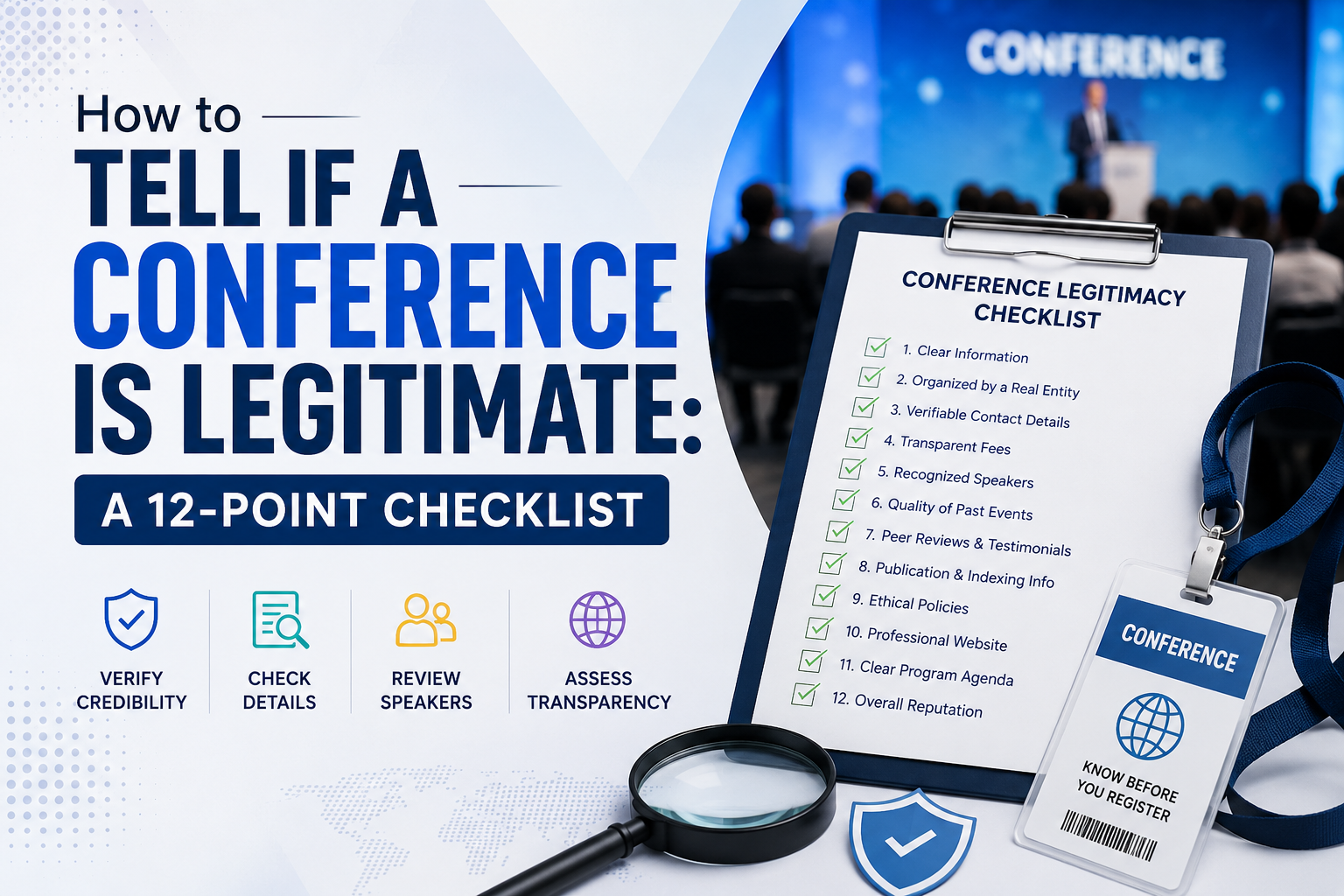
For the full routine, use our 12-point legitimacy checklist and read our complete guide to predatory conferences. You can also run any event through our free conference checker for an instant verdict.
The key differences
The scams are cousins, not twins:
- What they sell: a journal sells publication; a conference sells a presentation slot (and often a bundled "publication" on top).
- What it costs you: a predatory journal mainly damages your publication record; a predatory conference also costs you travel and time.
- How you verify: journals are checked against indexing databases and editorial transparency; conferences are checked against committees, history, and organiser legitimacy.
Despite these differences, the instinct that protects you is identical: never trust an unsolicited, fee-focused invitation at face value, verify independently first.
How they are often linked
The two frequently run together. A predatory conference may exist mainly to funnel your paper into a predatory journal for an extra fee, and a predatory journal may sponsor a conference to give itself a veneer of legitimacy. That is why an "indexed journal" promise attached to a conference is such a strong red flag: treat both the event and the journal as unverified until you have checked each independently.
How to check before you commit
A few minutes of verification defeats almost all of these scams:
- For a journal: check it on DOAJ and run through Think. Check. Submit..
- For a conference: run it through our conference checker, work through the checklist, and consult the independent Think. Check. Attend. initiative.
- If you have already been caught: our guide on what to do if you paid for a fake conference walks you through recovering your money and protecting your record.
Frequently asked questions
Are predatory journals and predatory conferences run by the same people? Often, yes. Many operators run both, and use each to lend false credibility to the other. The same caution applies to both.
Is a fee always a sign of a predatory venue? No. Legitimate open-access journals charge article processing fees, and real conferences charge registration. The warning signs are hidden fees, fees before review, and pressure, not the existence of a fee itself.
How do I check a journal is legitimate? Look it up on DOAJ, use Think. Check. Submit., verify the editorial board, and confirm any indexing claim directly with the indexing service.
How do I check a conference is legitimate? Run it through our conference checker and the 12-point checklist, and look for a strong ROCME score.
No comments yet. Be the first to share your thoughts.