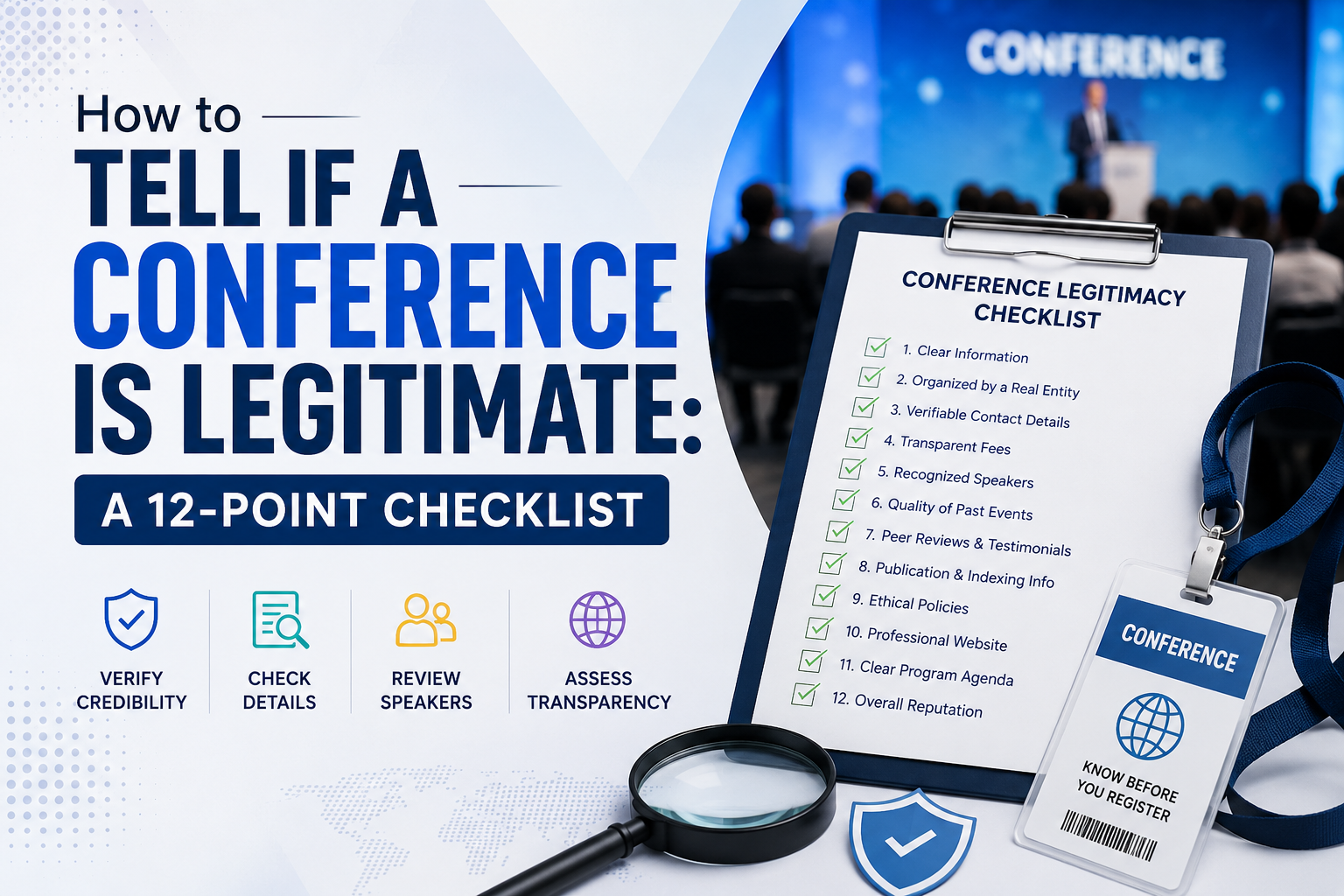
Every year, thousands of researchers and professionals lose money, and put their reputations at risk, by attending or presenting at predatory conferences: events designed to look legitimate but built only to collect registration fees. The good news is that fake conferences follow patterns. Once you know the warning signs, you can spot one in minutes.
This checklist walks you through 12 practical checks. Work through them before you pay a fee, book travel, or submit an abstract. If you'd rather have it done for you, you can run any event through our free conference checker at the end.
What is a predatory conference?
A predatory conference is an event whose real purpose is profit, not scholarship. Organizers mass-email invitations, accept almost every submission, charge high fees, and deliver little of the peer review, networking, or academic value a genuine conference provides. They often mimic the names of well-known conferences and list experts who never agreed to take part.
They're a close cousin of predatory journals, and frequently run by the same operators. Falling for one can cost you a registration fee, travel expenses, and, worse, a line on your CV that damages your credibility.
The 12-point legitimacy checklist
1. How did you hear about it?
Genuine conferences reach people through professional societies, colleagues, and field-specific channels. If your first contact was an unsolicited email, especially a flattering one calling you an "esteemed researcher", treat it with suspicion. Mass spam invitations are the single most common sign of a predatory event.
2. Does the scope make sense?
Real conferences are focused. Be wary of events that cover many unrelated fields at once, for example, "International Conference on Engineering, Medicine, Business and Social Sciences." A broad, catch-all scope exists to maximize paying attendees, not to advance any field.
3. How fast is acceptance?
Legitimate peer review takes weeks. If your abstract is accepted within 24–72 hours, or if acceptance is "guaranteed," there is no real review happening. That's a paper mill, not a conference.
4. Who's really on the committee?
Pick two or three names from the organizing or scientific committee and search for them. Do their university pages mention this conference? Predatory events routinely list famous academics who never agreed to participate, or who don't exist at all.
5. What does the fee structure look like?
Watch for pay-to-present pricing, where speakers are charged more than attendees, or where fees must be paid before any review. Legitimate events often reduce or waive speaker fees. Predatory ones make their money from presenters.
6. Does the name mimic a famous conference?
Copycat naming, adding "World," "International," or "Global" to a well-known conference brand, is designed to confuse you. Always find the official website of the real conference and compare.
7. How many events does the organizer run?
Search the organizer's name. Predatory companies run conference mills, dozens of "international conferences," sometimes in the same hotel on the same weekend. A genuine organizer runs a focused portfolio, not a flood of look-alike events.
8. Is there a verifiable history?
Real conferences show their past: last year's program, photos, and published proceedings. No verifiable history, no archives, no past speakers, no evidence it ever actually happened, is a serious red flag.
9. Can you actually reach a human?
Legitimate organizers are transparent about who and where they are. Be cautious if the only contact is a web form or a generic Gmail address, with no named organizer and no physical address.
10. What are the publication promises?
Predatory conferences lure submissions with claims of publication in "Scopus/ISI-indexed journals" that turn out to be unverifiable or themselves predatory. Verify any indexing claim independently before you believe it.
11. Do the venue and claims match?
A "global congress" held in a small hotel meeting room is a classic mismatch. Many victims report paying for a prestigious international event and finding twenty people in a side room.
12. Has anyone in your field heard of it?
Ask a supervisor or a few colleagues. Genuine conferences are known within their community and appear on professional societies' event lists. If nobody has heard of it and it's absent from society calendars, be very careful.
What to do if several signs are present
One or two minor flags don't automatically mean "scam", but several together are a strong warning. If you're seeing multiple signs:
- Do not pay any fee yet.
- Independently verify two or three committee members.
- Search the organizer's name together with the word "predatory."
- Check whether other researchers have reported it.
If you've already paid and suspect a fake, you're not alone and it's worth reporting so others are warned.
Verify any conference in one step
Working through 12 checks by hand is thorough, but you can get a fast second opinion. Confira's conference checker walks you through these research-based warning signs and gives you a clear risk verdict, alongside community reports from other researchers. Every conference on Confira also carries a ROCME score, our computed authenticity and quality rating, so you can see at a glance how trustworthy an event is.
If you're looking for legitimate opportunities instead, browse verified calls for papers and conferences already vetted on the platform.
Frequently asked questions
Are all conferences that charge fees predatory? No. Legitimate conferences charge fees to cover venues, catering, and organization. The warning sign isn't the fee itself, it's pay-to-present pricing, fees demanded before review, or costs that keep changing.
Is a fast acceptance always a bad sign? For peer-reviewed academic conferences, yes, genuine review takes time. Some professional or industry events don't peer-review talks, so judge acceptance speed in context, alongside the other signs.
What's the difference between a predatory conference and a predatory journal? A predatory journal publishes your paper for a fee without real peer review; a predatory conference charges you to present at a low-value event. They're often run by the same operators, and the same caution applies to both.
How can I check a specific conference quickly? Run it through our free conference checker. It scores the event against known warning signs and shows any community reports in seconds.
No comments yet. Be the first to share your thoughts.