Your abstract is the whole pitch. A reviewer often decides in under a minute whether your work belongs on the programme, and they decide from a few hundred words alone. The good news: strong abstracts follow a predictable shape. Learn it, and your acceptance rate climbs. This guide covers what reviewers look for, a template you can reuse, a worked example, and the mistakes that get abstracts rejected.
What reviewers are actually looking for
Reviewers are busy, and they are scanning for a few clear signals: Is the problem important? Is the contribution new? Is the method sound? And does it fit this conference? If your abstract answers those quickly and confidently, you are most of the way there. If a reviewer has to hunt for what is new or why it matters, that hesitation is often enough to land you in the reject pile.
The anatomy of a strong abstract
Almost every accepted abstract, in any field, moves through five beats:
- Context (1–2 sentences): the bigger picture and why this area matters.
- The gap or problem (1 sentence): what is missing, unresolved, or wrong today.
- What you did (1–2 sentences): your approach, study, or method, concrete, not vague.
- What you found (1–2 sentences): your key result or contribution. Be specific; numbers and clear findings beat "we discuss...".
- Why it matters (1 sentence): the implication for the field or practice.
That is the entire structure. Most weak abstracts fail because they spend three sentences on context and never clearly state the result.
A template you can reuse
> *Recent years have seen growing interest in [area], yet [the gap or unresolved problem] remains. In this work, we [what you did: study, method, dataset, approach]. We find that [key result, stated specifically]. These findings [implication], suggesting [why it matters for the field or practice].*
Fill each bracket with one concrete sentence and you will have a serviceable draft in ten minutes, then refine.
A worked example
*(A short, illustrative example, not real research.)*
> *Remote work has become permanent for millions, yet how it affects early-career mentorship is poorly understood. We surveyed 480 junior employees across 60 organisations and compared mentorship quality between remote, hybrid, and in-office teams. We find that hybrid teams reported the strongest mentorship outcomes, 22% higher than fully remote and comparable to in-office, driven by scheduled in-person time. These results suggest that deliberate, periodic co-location, rather than full remote or full office, best supports early-career development.*
Notice how it hits all five beats, leads with specifics, and states a clear, quantified finding.
Match the conference's scope
A brilliant abstract in the wrong room still gets rejected. Read the call carefully, note the tracks and keywords, and mirror that language where it honestly fits your work. Reviewers reward abstracts that clearly belong at their event. If you are choosing between venues, browse our conference listings to find events that match your topic, and before you invest time in a submission, make sure the event itself is legitimate (see the next section).
Common mistakes that get abstracts rejected
- Burying the contribution. If a reviewer cannot find what is new in ten seconds, revise.
- Vague results. "We discuss several factors" says nothing. State the finding.
- Too much background. One or two sentences of context is plenty.
- Scope mismatch. Submitting to a venue your work does not fit.
- Jargon and clutter. Write so a knowledgeable non-specialist understands it.
- Ignoring the guidelines. Word limits and formatting rules are the easiest points to win, or lose.
Before you submit: check the venue is real
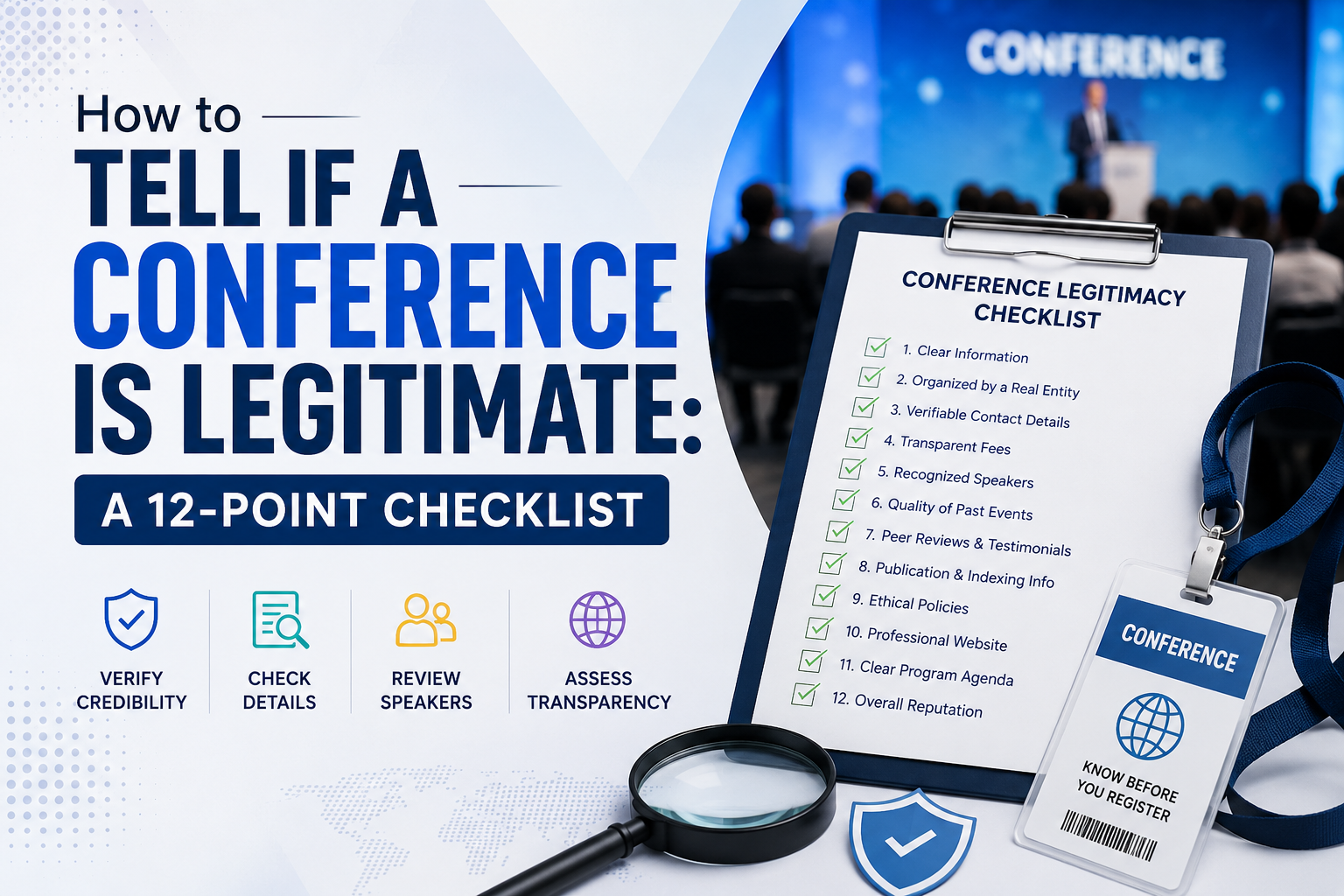
One more step that saves heartbreak: make sure the conference is genuine before you pour effort into a submission. Predatory conferences accept almost anything precisely to collect fees. Run any unfamiliar event through our free conference checker, skim the 12-point legitimacy checklist, and be wary of instant "acceptance", real review takes time. Our complete guide to predatory conferences explains the warning signs in full.
Frequently asked questions
How long should a conference abstract be? Follow the call's word limit exactly, commonly 150–300 words. Within that, aim for the five beats above rather than filling space.
Should I include results if my work is not finished? Include your strongest available finding, even if preliminary, and be honest about its stage. "We discuss..." with no result is the weakest possible ending.
How do I make my abstract stand out? Lead with a specific, clearly stated contribution, match the venue's scope, and cut every sentence that is not doing work. Clarity stands out more than cleverness.
How do I know the conference is worth submitting to? Check it with our conference checker and the 12-point checklist, and look for a strong ROCME score before you commit your work.
No comments yet. Be the first to share your thoughts.