If you have been invited to a Conferences Global event, or found conferencesglobal.org while checking whether a congress is real, this article is for you. We investigated the site directly: its public pages, the code behind those pages, and the WhatsApp number it tells everyone to contact. What we found raises serious concerns. We are not issuing a legal verdict. We are showing you the evidence so you can decide before you spend your registration fee, your travel budget, and your name. We invite the operator to respond, and will update this article with any correction they provide.
What Conferences Global presents itself as
The site describes itself as an international conference organizer running a 2026 to 2027 calendar of academic congresses across seven cities: Seoul, Berlin, Madrid, Vienna, Tokyo, Zurich and Shanghai. It lists fourteen events, including a "9th World Congress on Semiconductor Technologies, AI & Intelligent Electronics," an "18th Global Summit on Medicine & Clinical Research," a "21st World Congress on Materials & Nanoscience," and a "22nd World Congress on Materials Science, Nanoscience & Functional Engineering."
On the surface it looks polished. The details tell a very different story.
Red flag 1: Unrelated congresses share the same venue and dates
On the site's own listings, completely unrelated "congresses" are scheduled at the same place on the same days. Two entirely different events, one on medicine and one on environmental and earth sciences, are both booked into the same hotel in Shanghai on the same three days in October 2026. The 2027 calendar repeats the pattern in pairs: stem cell medicine with applied physics in Tokyo, biotechnology with medicine in Zurich, waste management with energy in Berlin, materials science with applied AI in Shanghai, each pair on identical dates.
Real conferences are built around one field and one community. Stacking unrelated subjects into the same room on the same dates is the signature of an operation selling registration slots, not running a scientific meeting.
Red flag 2: Unverifiable sponsors and speakers
The event pages display the logos of major, internationally recognised companies as "Diamond" and "Platinum" sponsors, and list named academics from real universities as keynote speakers, complete with photos.
We could not find any confirmation that those companies sponsor these events, or that those academics agreed to speak. And the site's own code (see below) shows the "keynote speakers" are selected at random from a list. Displaying prestigious logos and scholars you cannot verify is a classic device to borrow credibility.
Red flag 3: The website's own code gives it away
This is where it becomes hard to explain innocently. The pages were clearly built in a hurry with an AI assistant, and the assistant's own working notes were left sitting in the live code. Among the comments still in the page source:
- A note beside the "keynote speakers" section reading "KEYNOTES (10 random + link)." The speakers are pulled at random, not confirmed.
- A Google Ads tag with the comment "Replace with (this event's) own ID later." One advertising account is pasted across all the events.
- "like screenshot reference" beside a section, meaning the page was built by copying a screenshot of some other website.
We also found that:
- All fourteen "congresses" funnel every enquiry to one single UK WhatsApp number, and share one Google Ads advertising account. This is not fourteen organizations. It is one operator running one template.
- They are paying for Google Ads with conversion tracking on registrations, so their visitors are bought, not people who trust an established event.
- The "contact form" does not work at all. It submits to nowhere. Everything is designed to push you to the WhatsApp number and the payment page.
- One page's own share metadata still points to a different folder name, showing the pages are duplicated copies of a single template with details left unchanged.
Red flag 4: What happened when we contacted them
The site directs every enquiry to a WhatsApp number. We messaged it as an interested attendee and asked for basic details about the Madrid materials science congress. Here is exactly how it went:
- The number refuses voice calls: "Sorry. No voice calls are supported. This is for online chat." A real conference secretariat does not hide from a phone call.
- Asked for details, we were given none: no programme, no fee schedule, no confirmation of the venue booking, no name of any organizer. Every reply was a variation of "go to the website and register."
- We were immediately pushed with deadline pressure: "the deadline is nearing, please register."
- When we raised the warning signs, the operator dropped the polite act entirely and responded with a personal insult and a "come say it to my face" line, rather than a single piece of information about the event.
That is the behaviour of someone selling registrations, not someone running a scientific congress.
Red flag 5: Everything else that does not add up
- Inflated, identical statistics ("1000+ participants, 300+ speakers, 500+ posters") repeated as boilerplate across events that share a venue.
- Anonymous testimonials attributed only to generic roles, never a real named person.
- Implausibly high edition numbers ("18th," "21st," "22nd") with a hidden operator and a "past events" gallery of generic images that prove nothing.
- No named organizers or committee anywhere, only obfuscated emails and that one WhatsApp number.
- 2027 events with no venue at all, just a city, yet advertised as "confirmed." You cannot confirm a congress with no booked venue.
What this adds up to
Individually, one of these might have an innocent explanation. Together, they are overwhelming: one operator running fourteen unrelated "world congresses" from a single template, unrelated events double-booked on the same dates, unverifiable sponsors and randomly-generated speakers, a dead contact form, paid ads driving the traffic, a WhatsApp line that refuses calls and offers nothing but "register," and an operator who turns abusive the moment they are questioned.
We are not stating that any single event definitely will not happen. We are saying the evidence gives every reason for serious doubt, and we would strongly advise anyone to treat Conferences Global with extreme caution and to not pay a registration or travel cost without verifying independently.
How to protect yourself
- Do not pay anything yet. Once a registration or deposit is paid, that money is very hard to get back.
- Insist on a phone or video call with a named organizer. If they refuse, walk away.
- Verify the venue booking by contacting the hotel directly.
- Ask for a named organizer and a real programme with confirmed speakers, and verify a speaker through their university page, not the conference site.
- Check it on Confira. Run any conference through the Confira conference checker, and if you have dealt with this organizer, report your experience so the next researcher who searches finds the truth.
Frequently asked questions
Is conferencesglobal.org a legitimate conference organizer? Based on our investigation of its own website, its underlying code, and a direct conversation with its contact number, the site shows overwhelming warning signs of a fake or predatory operation, including unrelated congresses double-booked on the same dates, randomly-generated "keynote speakers," a single operator behind all fourteen events, a non-functional contact form, and a WhatsApp line that offers no real information and turns abusive when questioned. Verify independently and be extremely cautious before paying.
Are the sponsors and speakers real? We could not confirm that the displayed companies sponsor these events or that the listed academics agreed to speak, and the site's own code selects the "keynote speakers" at random.
I already registered or paid. What should I do? Contact your bank or card provider immediately about a chargeback, keep all screenshots and receipts, and report your experience so others are warned.
How do I check any conference, not just this one? Use the Confira conference checker.
This article is based on publicly available information from conferencesglobal.org, its own page source, and a direct communication with the contact number the site provides, at the time of writing. It reflects Confira's assessment of warning signs and is not a legal determination. If you operate Conferences Global and can provide evidence addressing these points, contact us and we will review and update this article.
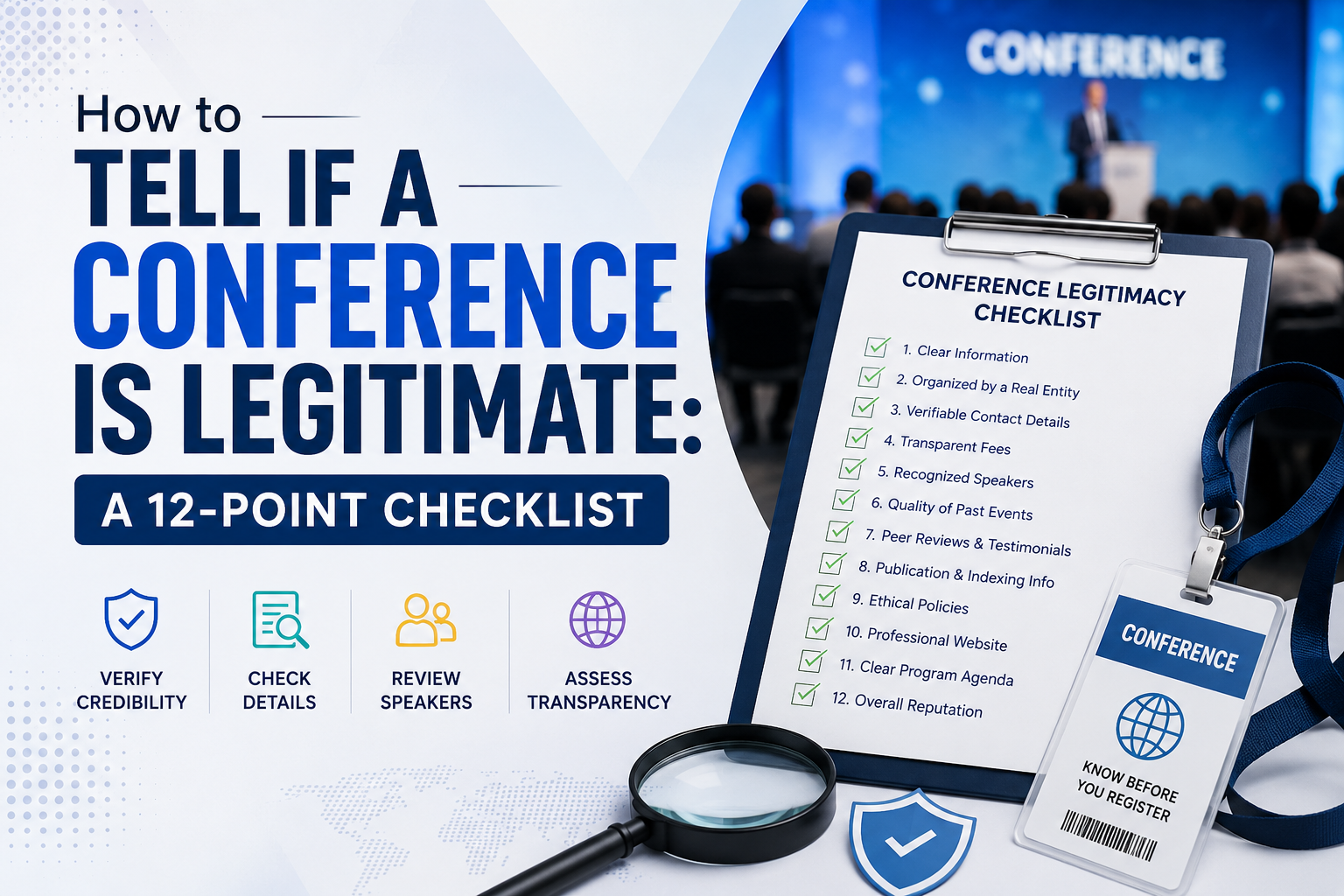
Further reading: Think.Check.Attend, the standard checklist academics use to judge whether a conference is genuine.
No comments yet. Be the first to share your thoughts.